The short answer: which is better for gaming?
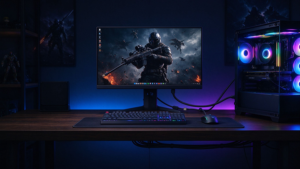
For PC gamers with a gaming monitor, DisplayPort is the better cable — and usually the only way to unlock G-Sync, 240Hz+ refresh rates and maximum bandwidth (up to 80 Gbps on DisplayPort 2.1).
Pour console gamers on a PS5 or Xbox Series X, HDMI 2.1 is mandatory — consoles only output through HDMI, and HDMI 2.1 delivers the 4K 120Hz VRR experience you paid for.
Bottom line: DP vs HDMI for gaming is not one winner — it is one answer per setup. Read on for the full DisplayPort vs HDMI comparison.
DisplayPort vs HDMI: What Are These Gaming Cables?
Before comparing DP vs HDMI for gaming, it helps to know what each interface was built for.
HDMI (interface multimédia haute définition) was designed by the consumer electronics industry for TVs, consoles, projectors and home theater gear. It is the universal connector of the living room — every PS5, Xbox Series X, TV and streaming box ships with an HDMI port, and HDMI 2.1 added the bandwidth (48 Gbps) that made 4K 120Hz console gaming possible.
DisplayPort (DP) was created by VESA specifically for computers — PC monitors, laptops, docking stations and workstations. It delivers more raw bandwidth per generation (up to 80 Gbps with DP 2.1), natively carries VESA Adaptive-Sync (the foundation of G-Sync and FreeSync), and even supports daisy-chaining multiple monitors through one port. That is why the best gaming monitor cables have historically been DisplayPort.
DP vs HDMI Bandwidth: The Spec That Decides Everything
In the DisplayPort vs HDMI argument, bandwidth is the single most important number — it decides how much resolution and refresh rate a cable can carry without compression.
DisplayPort has led every bandwidth generation since 1.4, and DisplayPort 2.1 at 80 Gbps (UHBR20) still beats HDMI 2.1 at 48 Gbps by roughly 67% in raw throughput — about 82% more effective data rate (77.4 vs 42.6 Gbps). That headroom is exactly why DP 2.1 can drive 4K 240Hz with full 10-bit 4:4:4 color uncompressed, while HDMI 2.1 needs Display Stream Compression (DSC) for the same mode.
The story shifted in 2025: HDMI 2.2 doubled the ceiling to 96 Gbps using new FRL2 signaling, finally overtaking DP 2.1 on paper. However, HDMI 2.2 ports and displays only started appearing in 2026 — for most gamers today, the practical contest is still DP 2.1 vs HDMI 2.1.

| Standard | Year | Raw bandwidth | Effective data rate | 4K refresh (native) | 8K support |
|---|---|---|---|---|---|
| HDMI 2.0 | 2013 | 18 Gbps | ~14.4 Gbps | 4K 60Hz | Non |
| DP 1.4 | 2016 | 32.4 Gbps | ~25.9 Gbps | 4K 60Hz (120Hz w/ DSC) | 8K 30Hz (60Hz w/ DSC) |
| HDMI 2.1 | 2017 | 48 Gbps | ~42.6 Gbps | 4K 120Hz | 8K 60Hz (w/ DSC) |
| DP 2.1 | 2022 | 80 Gbps (UHBR20) | ~77.4 Gbps | 4K 240Hz | 8K 120Hz (w/ DSC) |
| HDMI 2.2 | 2025 | 96 Gbps (FRL2) | ~96 Gbps | 4K 240Hz | 8K 60Hz native / 8K 240Hz |
What bandwidth means for your frame rate
More bandwidth = higher resolution + higher refresh rate sans compression. When bandwidth runs out, the GPU and monitor fall back on DSC — visually lossless for most games, but it can occasionally add a frame of latency and restrict some VRR ranges on older hardware.
HDMI 2.1 vs DisplayPort 2.1: Full Spec Comparison Table
Here is the complete DP vs HDMI comparison for gamers, feature by feature.
| Fonctionnalité | DisplayPort 2.1 DP | HDMI 2.1 HDMI | Edge |
|---|---|---|---|
| Max raw bandwidth | 80 Gbps (UHBR20) | 48 Gbps | DP — 67% more |
| Effective data rate | ~77.4 Gbps | ~42.6 Gbps | DP |
| 4K uncompressed | 240Hz | 120Hz | DP |
| 4K with DSC | 480Hz | 144Hz practical | DP |
| 8K support | 120Hz (w/ DSC) | 60Hz (w/ DSC) | DP |
| Variable Refresh Rate | VESA Adaptive-Sync | HDMI Forum VRR | Even |
| NVIDIA G-Sync | Native / best support | Compatible on newer displays | DP |
| AMD FreeSync | Yes (native) | Yes (variable) | DP (most stable) |
| ALLM (auto low latency) | N/A (low latency by design) | Oui | HDMI (TVs) |
| DSC compression | Yes (1.2a) | Yes (1.2a) | Even |
| HDR formats | HDR10, HDR10+ | HDR10, HDR10+, Dolby Vision | HDMI |
| eARC audio return | Non | Yes (Atmos / DTS:X) | HDMI |
| Daisy-chaining (MST) | Oui | Non | DP |
| Console support (PS5 / Xbox) | Non | Yes — the only option | HDMI |
| Typical max passive cable length | ~2m (UHBR20 shorter) | ~3m+ (10ft certified) | HDMI |
| Licensing cost for makers | Royalty-free | License fee per device | DP |
Reading the table: DisplayPort wins on raw performance and PC-specific sync features; HDMI wins on console compatibility, Dolby Vision and eARC for TVs. Neither cable is “objectively better” for gaming — the best cable depends on what you plug it into.
VRR, G-Sync & FreeSync: Why DP Dominates PC Gaming
The biggest practical difference in the DP vs HDMI for gaming debate is how each cable handles screen tearing.
Taux de rafraîchissement variable (VRR) lets a gaming monitor sync its refresh rate to your GPU’s frame rate, eliminating screen tearing and stutter. On PC, VRR runs on two ecosystems: NVIDIA G-Sync et AMD FreeSync — and both are built on VESA Adaptive-Sync, which DisplayPort carries natively.
Historically, G-Sync only worked over DisplayPort. Today, many “G-Sync Compatible” monitors still deliver their most stable VRR range over a DP cable, which is why competitive gamers reach for DisplayPort first. HDMI 2.1 added official HDMI Forum VRR support, but it shines where it matters most: consoles.
- PC + NVIDIA GPU: DisplayPort — full G-Sync range, no fuss
- PC + AMD GPU: DisplayPort — most stable FreeSync range
- PS5 / Xbox Series X: HDMI 2.1 VRR — consoles support HDMI only
- 4K TV gaming: HDMI 2.1 — VRR + ALLM + eARC in one cable

4K 144Hz, 240Hz & 8K: What Each Cable Can Actually Drive

At 1440p (the esports sweet spot), almost any modern cable works: DP 1.4 runs 1440p at 240Hz natively, and HDMI 2.0 runs 1440p at 144Hz. At 4K, the version matters: HDMI 2.0 caps at 4K 60Hz, while HDMI 2.1 hits 4K 120Hz native and DP 2.1 reaches 4K 240Hz uncompressed.
Pour 8K gaming, both current-gen interfaces rely on DSC: HDMI 2.1 manages 8K 60Hz, DisplayPort 2.1 doubles that to 8K 120Hz. HDMI 2.2 (2026 displays) finally delivers 8K 60Hz uncompressed with 10-bit color.
| Gaming setup | Minimum cable | Best cable | Notes |
|---|---|---|---|
| 1080p 144Hz / 165Hz | HDMI 2.0 / DP 1.2 | DP 1.4 or HDMI 2.0+ | Nearly any modern cable works |
| 1440p 144Hz | HDMI 2.0 / DP 1.4 | DP 1.4 | Full refresh without compression |
| 1440p 240Hz / 360Hz | DP 1.4 | DP 1.4 / 2.1 | DisplayPort is the esports standard |
| 4K 60Hz | HDMI 2.0 / DP 1.2 | Either | Both cables handle it easily |
| 4K 120Hz (console) | HDMI 2.1 | HDMI 2.1 | PS5 / Xbox Series X require HDMI 2.1 |
| 4K 144Hz (PC) | HDMI 2.1 (DSC) / DP 1.4 (DSC) | DP 2.1 / HDMI 2.2 | Uncompressed needs DP 2.1 or HDMI 2.2 |
| 4K 240Hz (PC) | DP 2.1 | DP 2.1 UHBR20 | Only DP 2.1 / HDMI 2.2 (DSC) can do it |
| 8K 60Hz+ | HDMI 2.1 (DSC) | DP 2.1 / HDMI 2.2 | DP 2.1 = 8K 120Hz with DSC |
HDMI vs DisplayPort: Cable Length, Quality & Console Compatibility
Cable length matters more than most gamers think. High-bandwidth signals degrade over distance: certified HDMI 2.1 “Ultra High Speed” cables are rated for about 3 meters (10 ft) of reliable passive signal, while DisplayPort 1.4/2.1 passive cables should stay under 2 meters — DP 2.1 at UHBR20 is even more sensitive, often 1 meter or less. For longer runs you need an active cable or fiber optic (AOC) cable.
Consoles change the equation. The PS5 and Xbox Series X only output video through HDMI. To play at 4K 120Hz with VRR on a modern TV, you need a certified HDMI 2.1 Ultra High Speed cable — no DisplayPort involved.
- TV / console gaming: HDMI 2.1 — VRR, ALLM, eARC, Dolby Vision
- Desktop PC < 2m: DisplayPort — highest refresh, best sync
- Long runs (5–15m): active / optical cable, HDMI has more options
- Adaptateurs : work for output, but may block 4K 144Hz, VRR and HDR

Which Cable Should You Use? DP vs HDMI for Every Gamer
| Your scenario | Recommended connection | Why |
|---|---|---|
| PC + 144Hz / 165Hz gaming monitor | DisplayPort 1.4 | Full refresh rate, stable FreeSync / G-Sync |
| PC + 240Hz / 360Hz esports monitor | DisplayPort 1.4 / 2.1 | DisplayPort is the only reliable path past 144Hz at 1440p+ |
| PC + 4K 144Hz monitor | DP 2.1 ou HDMI 2.2 | Uncompressed 10-bit 4:4:4 without DSC |
| PC + 4K 240Hz flagship monitor | DP 2.1 UHBR20 | Only DP 2.1 (or HDMI 2.2 w/ DSC) reaches it |
| PS5 / Xbox Series X | HDMI 2.1 | Consoles have no DisplayPort output |
| 4K TV + PC (living room gaming) | HDMI 2.1 | VRR + ALLM + eARC in one connection |
| Multi-monitor daisy chain | DisplayPort MST | DP chains monitors; HDMI cannot |
| Long cable run (5m+) | HDMI (active/AOC) | More certified long-range options |
| 8K gaming / future-proofing | DP 2.1 / HDMI 2.2 | Both support 8K 120Hz+ with DSC |