240W USB-C Cable: The Ultimate Guide to USB PD 3.1 EPR Fast Charging
The era of carrying a bulky, proprietary laptop charger is officially over. Thanks to the 240W USB-C cable powered by USB PD 3.1 EPR (Extended Power Range), a single USB-C fast charge cable can now deliver enough juice to run high-performance gaming laptops, mobile workstations, and even small appliances that once required their own dedicated power bricks.
If you’ve been shopping for a new USB-C cable lately, you’ve probably noticed the term “240W” popping up everywhere. But what exactly is a 240W EPR cable? How does it differ from a standard 100W USB-C cable? And do you actually need one? In this comprehensive guide, we break down everything you need to know about 240W power delivery, the USB PD 3.1 EPR standard, and how to choose the best 240W USB-C to USB-C cable for your setup.
What Is a 240W EPR USB-C Cable?
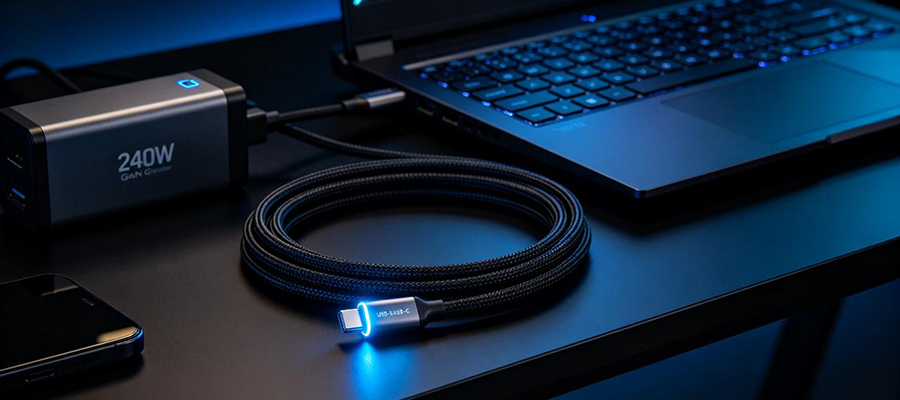
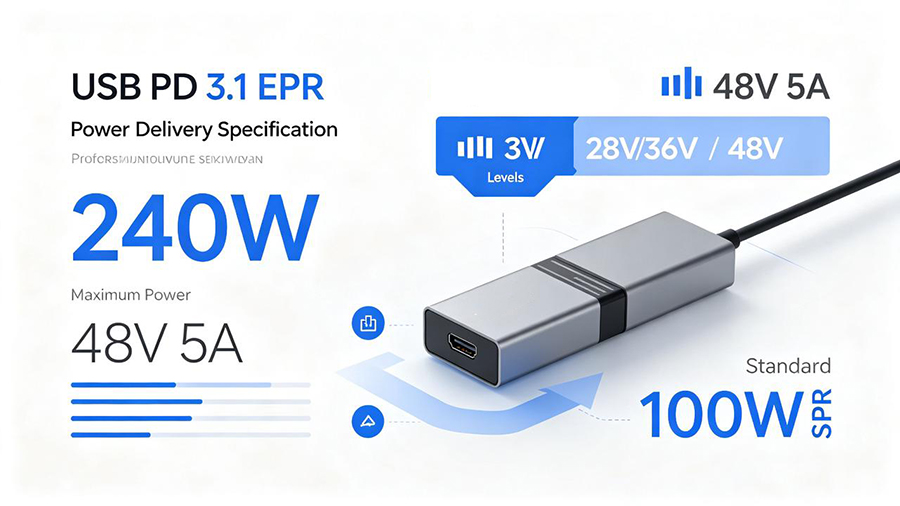
240W USB-C cable is a high-power USB-C to USB-C cable that supports the USB Power Delivery 3.1 Extended Power Range (EPR) specification. Unlike standard USB-C cables capped at 100W (Standard Power Range, or SPR), a 240W EPR cable can safely deliver up to 240 watts of power — that’s 48V at 5A — making it the most powerful USB-C charging solution currently available.
En USB PD 3.1 EPR standard, released by the USB-IF, introduced three new fixed voltage levels beyond the traditional 20V maximum:
-
28V — for ultrabooks and compact laptops
-
36V — for mainstream gaming laptops and all-in-one PCs
-
48V — for high-end gaming laptops, workstations, and professional equipment
Every genuine 240W USB-C cable must include an E-Marker chip (electronic marker chip) that communicates the cable’s power and data capabilities to the connected devices. This chip ensures that your charger, cable, and device all negotiate the correct voltage and current — preventing overheating, damage, or dangerous power surges.
USB PD 3.1 EPR vs. Standard PD: What’s the Difference?
Understanding the gap between a standard 100W USB-C cable y un 240W EPR USB-C cable is crucial for making the right purchasing decision. Here’s a side-by-side comparison:
|
Característica
|
Standard USB PD (SPR)
|
USB PD 3.1 EPR (240W)
|
|---|---|---|
|
Potencia máxima
|
100W (20V / 5A)
|
240W (48V / 5A)
|
|
Voltage Levels
|
5V, 9V, 15V, 20V
|
5V, 9V, 15V, 20V, 28V, 36V, 48V
|
|
E-Marker Required
|
Required for 5A (100W) cables
|
Mandatory for all EPR cables
|
|
Caso típico
|
Smartphones, tablets, ultrabooks
|
Gaming laptops, workstations, monitors, small appliances
|
|
Conductor Gauge
|
22–24 AWG common
|
20 AWG or thicker (16–18 AWG premium)
|
|
USB-IF Certification
|
Recommended
|
Strongly recommended for safety
|
|
Market Position
|
Current mainstream standard
|
Emerging premium standard — fastest-growing segment in 2026
|
Why 240W USB-C Cables Are Changing the Game
The rise of the 240W USB-C cable isn’t just about bigger numbers — it represents a fundamental shift in how we power our devices. Here’s why 240W EPR technology is generating so much excitement in 2026:
-
One Cable for Everything
Imagine a world where your 240W USB-C to USB-C cable charges your smartphone, your tablet, your ultrabook, y your 200W gaming laptop — all from a single 240W GaN charger. That world is here. With 240W power delivery, the USB-C connector has finally become a true universal power standard, replacing the proprietary barrel connectors that have plagued laptops for decades.
-
Gaming Laptops Go USB-C
Brands like ASUS ROG, Lenovo Legion, and Acer Predator are now equipping their flagship gaming laptops with USB-C charging support up to 240W. A quality 240W gaming laptop USB-C cable means you can leave the 2kg power brick at home and travel with a compact GaN charger instead — a game-changer for LAN parties, business trips, and dorm-room setups.
-
EU Common Charger Directive
The European Union’s Common Charger Directive, which mandates USB-C for all new laptops sold in the EU starting April 2026, is accelerating the adoption of high-power USB-C fast charge cables. As manufacturers phase out proprietary chargers, demand for 240W EPR USB-C cables is expected to surge across Germany, France, the UK, and beyond.
-
Prepare su instalación para el futuro
Even if your current laptop only needs 65W or 100W, investing in a 240W USB-C cable ensures you’re ready for your next device. As more laptops, monitors, and even desktop PCs adopt USB PD 3.1 EPR, a 240W cable will remain useful for years — unlike a 60W cable that may become obsolete when you upgrade.
Key Features of a Quality 240W USB-C Cable
Not all 240W USB-C cables are created equal. When shopping for the best 240W EPR cable, look for these essential features:
-
USB-IF Certification: A USB-IF certified 240W cable has passed rigorous electrical, mechanical, and protocol testing. Look for the official USB-IF logo or a valid certification ID (TID).
-
Built-in E-Marker Chip: Mandatory for safe 240W operation. The E-Marker chip negotiates power levels between your charger and device, preventing overloads.
-
Thick Conductors (20 AWG or lower): Higher wattage requires thicker copper wire. Premium 240W USB-C cables use 16–20 AWG conductors to minimize resistance and heat buildup.
-
Braided Exterior: A 240W braided USB-C cable with nylon or aramid fiber construction resists fraying, kinking, and abrasion — ideal for frequent travel and heavy use.
-
Reinforced Strain Relief: The connector-to-cable junction is where most cables fail. Look for molded, flexible strain relief rated for 10,000+ bend cycles.
-
Gold-Plated Connectors: Gold plating resists corrosion and ensures a stable, low-resistance connection over thousands of insertions.
-
Data Transfer Capability: Some 240W cables are charge-only. If you need video output (8K@60Hz via DP Alt Mode) or high-speed data (USB4 / Thunderbolt 5), choose a full-featured 240W USB-C cable.
Who Needs a 240W EPR USB-C Cable?
|
User Type
|
Why They Need 240W EPR
|
Dispositivos de ejemplo
|
|---|---|---|
|
Jugadores
|
Power high-performance gaming laptops that draw 150–230W under load; replace bulky proprietary chargers
|
ASUS ROG Zephyrus, Lenovo Legion Pro, Acer Predator Triton
|
|
Content Creators
|
Charge mobile workstations and power 8K monitors over a single cable; daisy-chain peripherals
|
MacBook Pro 16″, Dell XPS 17, HP ZBook Studio, LG 8K monitors
|
|
Digital Nomads
|
Travel with one compact 240W GaN charger + one cable for all devices; reduce bag weight
|
Any USB-C laptop, tablet, smartphone, portable SSD
|
|
Office / IT Managers
|
Standardize on one cable type for all employee devices; reduce e-waste and charger inventory
|
Mixed fleet of laptops, monitors, and docking stations
|
|
Tech Enthusiasts
|
Future-proof their cable collection; experiment with USB PD 3.1 EPR peripherals and DIY projects
|
Custom PCs, mini-ITX builds, portable power stations
|
240W USB-C Cable vs. Traditional Laptop Chargers
|
Aspect
|
Traditional Proprietary Charger
|
240W USB-C Cable + GaN Charger
|
|---|---|---|
|
Peso
|
500g – 1.2kg (bulky brick)
|
150g – 350g (compact GaN)
|
|
Universality
|
Brand/model-specific only
|
Works with all USB-C devices
|
|
Travel Convenience
|
Need separate chargers for each device
|
One 240W GaN charger + cable for everything
|
|
Replacement Cost
|
$50 – $150 (OEM only)
|
$15 – $40 (cable), $40 – $80 (GaN charger)
|
|
Data / Video
|
Power only
|
Power + data + 8K video (full-featured cable)
|
|
Eco-Friendliness
|
E-waste when upgrading laptops
|
Reusable across devices; reduces e-waste
|
Common Mistakes to Avoid with 240W USB-C Cables
-
Buying the cheapest cable: A $5 “240W” cable from an unknown seller almost certainly lacks proper E-Marker implementation and thick enough conductors. It may overheat or fail under load.
-
Ignoring the charger’s wattage: A 240W USB-C cable can’t deliver 240W if your charger only outputs 65W. Make sure your charger supports the required wattage and USB PD 3.1 EPR protocol.
-
Confusing charge-only with data cables: Some 240W cables don’t support data transfer or video output. If you need a single-cable docking station setup, confirm the cable supports USB 3.2 Gen 2 or USB4 data rates.
-
Using a damaged cable: If your 240W EPR cable shows fraying, exposed wires, or bent connectors, stop using it immediately. High-power cables under physical stress are a safety risk.
-
Assuming all USB-C ports support 240W: Even with a 240W cable, your device’s USB-C port must support USB PD 3.1 EPR input. Check your laptop’s specifications — many ultrabooks are capped at 65–100W.
PREGUNTAS FRECUENTES
Q: Can a 240W USB-C cable charge my phone?
Absolutely. A 240W USB-C cable is backward compatible and will automatically negotiate the correct power level for your smartphone (typically 18–65W). It won’t “overcharge” your device — the E-Marker chip and PD protocol ensure safe, efficient charging.
Q: Do I need a special charger for a 240W EPR cable?
Yes. To get the full 240W, you need a charger that supports USB PD 3.1 EPR with 28V, 36V, or 48V output. A standard 100W PD charger will still work, but it’s limited to 100W. Look for a 240W GaN charger for the best combination of power and portability.
Q: What’s the difference between 240W EPR and 100W SPR cables?
The main difference is voltage support. A 100W SPR cable tops out at 20V, while a 240W EPR cable supports up to 48V. EPR cables also require more robust construction (thicker conductors, mandatory E-Marker) to handle the higher power safely.
Q: Are 240W USB-C cables safe?
When properly certified and used with compatible equipment, 240W USB-C cables are extremely safe. The USB PD 3.1 EPR specification includes multiple layers of protection: E-Marker authentication, voltage/current negotiation, overcurrent protection, and thermal monitoring. Always choose USB-IF certified 240W cables from reputable brands.
Q: Can a 240W cable support 8K video and Thunderbolt 5?
Some do, but not all. If you need 8K@60Hz video output (via DisplayPort Alt Mode) or Thunderbolt 5 / USB4 data speeds (up to 80Gbps), look for a full-featured 240W USB-C cable that explicitly lists these capabilities. Charge-only 240W cables typically only support USB 2.0 data speeds (480Mbps).
Q: How long should a 240W USB-C cable last?
A well-built 240W braided USB-C cable with reinforced strain relief should last 2–5 years under normal use. Premium cables are often rated for 10,000+ bend cycles and 10,000+ insertions. Cheaper alternatives may fail within 3–6 months.