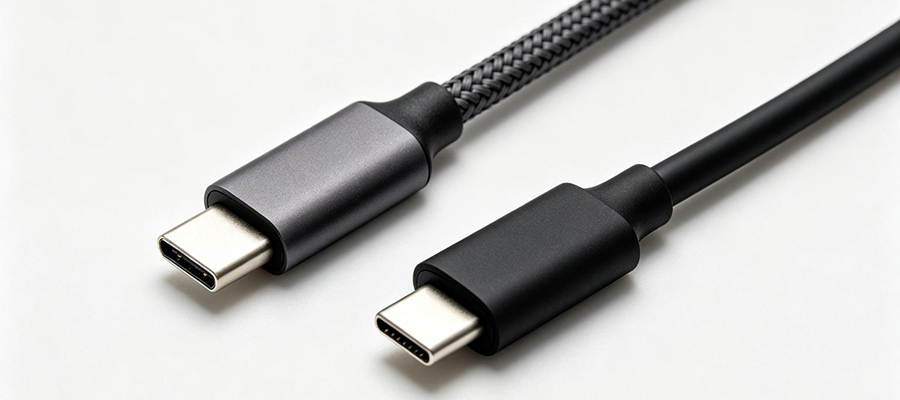
When shopping for USB-C cables, you’ll notice two main exterior types: braided nylon и rubber (TPE/PVC). Both charge your devices — but they perform very differently when it comes to durability, heat management, and real-world lifespan. Let’s break down which one is worth your money.
1. Durability: Build Quality & Physical Resilience
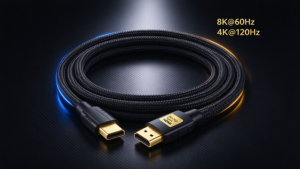
Braided cables feature a woven nylon or polyester outer layer that adds significant abrasion resistance. The braided structure distributes stress across multiple fibers, making these cables far more resistant to fraying, tearing, and damage from daily bending or tangling.
Rubber (TPE/PVC) cables use a smooth, flexible polymer jacket. While they feel soft and bend easily, the rubber surface is prone to cracking, peeling, and fraying — especially at the connector joints where stress concentrates.
-
Braided: Excellent abrasion resistance, less fraying, better tangle resistance
-
Rubber: Softer feel, more flexible, but prone to cracking and wear at stress points
2. Heat Dissipation: Thermal Performance Matters
Heat is the silent killer of cable lifespan — especially with fast charging at 65W, 100W, or even 240W. How well a cable dissipates heat directly impacts its internal components and longevity.
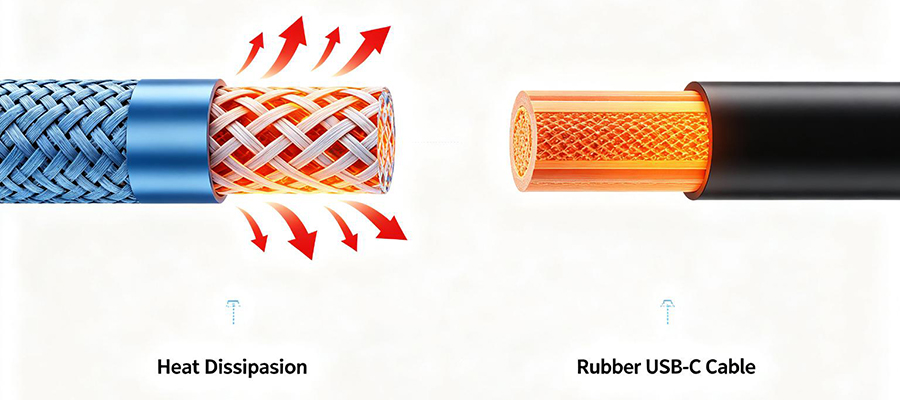
Braided cables have tiny gaps between woven fibers that allow air circulation. This breathable structure helps heat escape from the cable core more effectively, keeping internal temperatures lower during high-power charging.
Rubber cables form a solid, non-porous barrier that traps heat inside. Under heavy loads (100W+), rubber jackets can feel noticeably warmer to the touch — and that trapped heat accelerates degradation of internal insulation and solder joints.
3. Lifespan: Long-Term Value Comparison
While rubber cables are often cheaper upfront, braided cables typically deliver 2–3x longer service life under real-world use.
Braided cables commonly last 1–3 years with daily use, thanks to superior abrasion resistance and better thermal management. The woven outer layer protects internal wires from both physical damage and heat-related degradation.
Rubber cables often fail within 6–12 months of heavy use. The most common failure points are cracked jackets near connectors, frayed wiring, and intermittent connections caused by heat-weakened solder joints.
Quick Comparison Table
|
Характеристика
|
Braided USB-C
|
Rubber USB-C
|
|---|---|---|
|
Долговечность
|
Excellent — abrasion-resistant
|
Moderate — prone to cracking
|
|
Heat Dissipation
|
Better — breathable weave
|
Poorer — traps heat
|
|
Typical Lifespan
|
1–3 years
|
6-12 месяцев
|
|
Гибкость
|
Stiffer
|
More flexible
|
|
Цена
|
Higher upfront
|
Cheaper
|
|
Tangle Resistance
|
Better
|
Prone to tangling
|
Which Cable Should You Choose?
Choose braided if:
-
You use fast charging (65W+) regularly
-
The cable travels with you (bag, pocket, desk-to-bag)
-
You want better long-term value
-
Durability and heat management matter most
Choose rubber if:
-
You need a budget-friendly, disposable cable
-
It stays in one place (home charger, stationary setup)
-
You prefer a softer, more flexible feel
-
You only charge at low wattages (≤27W)
Окончательный вердикт
For most people — especially anyone using fast charging or carrying cables around — braided USB-C cables are the better investment. They cost a bit more upfront, but their superior durability, better heat dissipation, and 2–3x longer lifespan mean you’ll spend less replacing cables over time. Rubber cables have their place for light, stationary use, but they simply can’t match braided cables for real-world longevity.