A USB-C cable has five layers, and the braid does the least electrical work
Strip a USB-C cable back and you find, from the inside out: copper conductors, insulation around each one, a shield made of foil and a drain wire, the outer jacket, and — on a braided USB-C cable — a woven nylon layer wrapped around all of it.
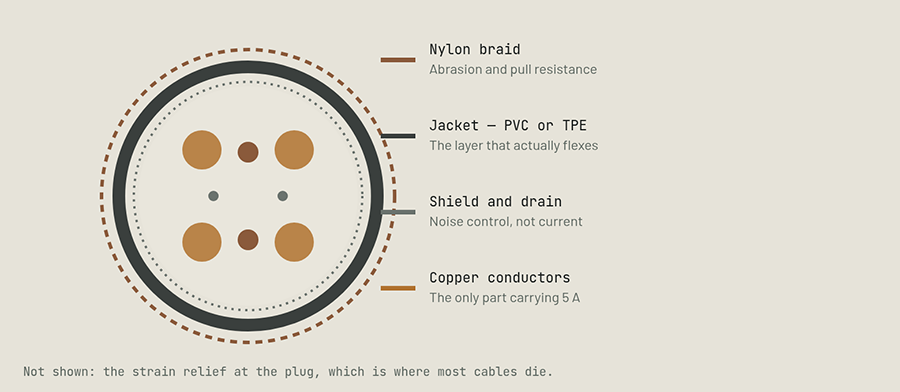
This matters because the braid protects the jacket; it does not make the cable conduct better. Two 1 m cables with the same conductor gauge and the same load dissipate the same heat whether the outside is moulded PVC or a tightly woven nylon sleeve. What changes is how long that outside survives the heat, the abrasion and the bending.
So when a listing says “nylon braided USB-C cable, 10,000 bend life”, you are reading two different claims at once: one about the surface, one about the whole assembly. They are rarely tested together, and the second is the one that decides whether the cable is still working in eighteen months.
Three places a cable breaks, and the braid only touches one of them
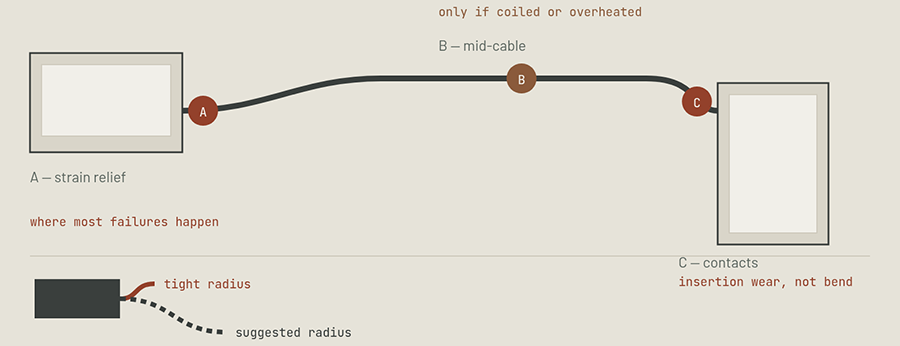
At the strain relief. This is the 8 to 15 mm where a flexible jacket meets a rigid connector shell. The bend radius is at its smallest, so every sharp angle concentrates fatigue into a few square millimetres of material. This is the failure the braid is supposed to fix.
At the contacts. Insertion wear is a different mechanism entirely. A cable plugged in and out several times a day wears the contacts and the shell; no amount of nylon changes that.
Mid-cable. Conductors break here when the cable has been wrapped around a charger brick, a laptop hinge or a car mirror, or pulled at an angle for a year. It is the least common of the three and the easiest to prevent.
Heat comes from copper, so measure the copper
Charging heat is resistive loss in the conductors, and it scales with the square of current. At 5 A — the ceiling for a 240 W USB-C cable — the difference between a good conductor and a thin one is not subtle. The figures below are per metre of cable, counting both the power conductor and the return path.
| Манометр | Resistance | Drop at 5 A | Heat at 5 A | Where it is used |
|---|---|---|---|---|
| 20 AWG | 0.033 Ω/m | 0.33 V/m | 1.7 W/m | 240 W, 5 A rated cables |
| 22 AWG | 0.053 Ω/m | 0.53 V/m | 2.6 W/m | 100–240 W, shorter runs |
| 24 AWG | 0.084 Ω/m | 0.84 V/m | 4.2 W/m | 60–100 W, 1–2 m |
| 26 AWG | 0.134 Ω/m | 1.34 V/m | 6.7 W/m | Data-first, short charging runs |
| 28 AWG | 0.212 Ω/m | 2.12 V/m | 10.6 W/m | Charge-only leads under 1 m |
The 1.7 W that a 20 AWG cable loses per metre is 0.7% of a 240 W load, which is why 240 W runs cool at 48 V. Move to 24 AWG and you are at 4.2 W per metre: over 2 m that is roughly 8% of a 100 W charge going into the jacket instead of the battery. That warmth is the reason thin high-wattage cables get noticeably soft and why a cable left coiled around a warm laptop brick ages faster than the one on your desk.
What a 10,000-bend number is actually measuring
A cycle count without test conditions is a slogan. Four parameters decide whether two numbers can be compared at all:
| Параметр | Common claims | What it changes |
|---|---|---|
| Bend angle | ±90° / ±180° | A 180° fold stresses the jacket roughly twice as much per cycle as a 90° bend. |
| Mandrel radius | 5 mm / 10 mm | Halving the radius concentrates strain; 10,000 cycles on a 5 mm mandrel is a much harder test. |
| Load | 0 g / 500 g | Hanging weight turns a bend test into a bend-plus-tension test. |
| Pass criteria | continuity / appearance | “No jacket cracking” and “no data errors” are different bars, and the second is the useful one. |
Two cables can both print 10,000 and be a generation apart. When a spec sheet gives you only the number, ask for the test report; a supplier who has actually run the test usually has the angle and radius within a page of it. If the answer is “industry standard”, there is no single number everyone quotes, and the claim is being used as a substitute for evidence.
Not all braid is braid
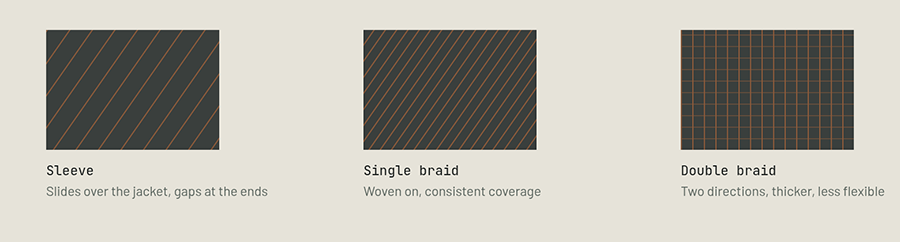
Denier tells you the thread weight — 250D is a light weave, 500D is heavier and more abrasion-resistant but stiffer. Coverage tells you whether the weave closes on itself. A sleeve with visible gaps will snag on a zipper, pull loose at the ends and let grit straight through to the jacket underneath.
A five-second test in a shop: pinch the braid between two fingers and slide. If it bunches into a loose tube over a separate inner jacket, it is a sleeve. Then drag a key lightly along it; a tight weave deflects, a loose one catches and pills. Neither of these tells you the cable will last, but they tell you whether you are paying for braid or for the word braid.
What ends a cable before its bend rating does
- Pulling by the cable, not the plug. The braid distributes force across the surface, but the connector’s strain relief is what actually holds the assembly. Yank the cord and you load the solder joints, not the weave.
- Coiling around the charger or the laptop. Tight wraps put a permanent bend into the jacket and stack that against the heat of the brick. A loose loop costs ten seconds.
- A stand or mount that loads the plug sideways. Laptop risers, phone holders and car mounts all bend at exactly point A. A right-angle USB-C cable exists for this and is the cheapest fix you can buy.
- Pets. Nylon braid gives a cat or a puppy more grip than smooth PVC. Braid survives the first bite better and then unravels spectacularly; PVC tends to fail at the conductor.
- Heat and sunlight in a car. A dashboard in summer will exceed the continuous rating of many PVC jackets. No cable should live there, braided or not.
- Pocket angles. A phone in a front pocket with a cable plugged in puts a permanent 90° load on the plug for hours at a time. Braid helps the jacket; nothing helps the contacts.
Questions we get from buyers
- Is a braided USB-C cable always more durable than PVC?
- No. Braid adds abrasion resistance and a nicer feel, but if the weave stops short of the strain relief, the part that actually fails is unchanged. A well-built TPE cable with a long moulded strain relief will outlast a cheap braided one.
- My braided cable still broke at the plug. Why?
- Because that is where the bend radius is smallest and where pull force concentrates. Braid protects the jacket from abrasion; it does not stop fatigue in the copper behind the plug. A right-angle cable or a mount that stops the sideways load does more for that failure than a heavier braid.
- What does a 10,000-bend rating actually mean?
- That the cable survived 10,000 cycles under the manufacturer’s stated conditions. Those conditions — angle, mandrel radius, load and pass criteria — are the part that makes the number useful. Always ask for them.
- PVC or braided for a car?
- Braided for abrasion and appearance, but heat is the bigger risk in a car, and neither jacket fixes that. Keep the cable out of direct sun and off the dashboard; if it lives in a mount, use a right-angle plug so the bend is not permanent.