Braided or Silicone USB‑C Cables: Which Is More Durable?
Release Date:03/24/2026
Оглавление
Ever pulled your USB-C cable out of your backpack right before a client meeting, only to find the outer casing split at the connector? You’re not alone: 78% of USB-C cable failures come down to choosing the wrong outer material, not bad internal wiring. If you’re torn between braided vs silicone USB-C cables, this guide breaks down exactly which lasts longer, feels better, and gives you the most bang for your buck.
Braided cables use a tightly woven nylon/polyester outer layer over the standard PVC insulation:
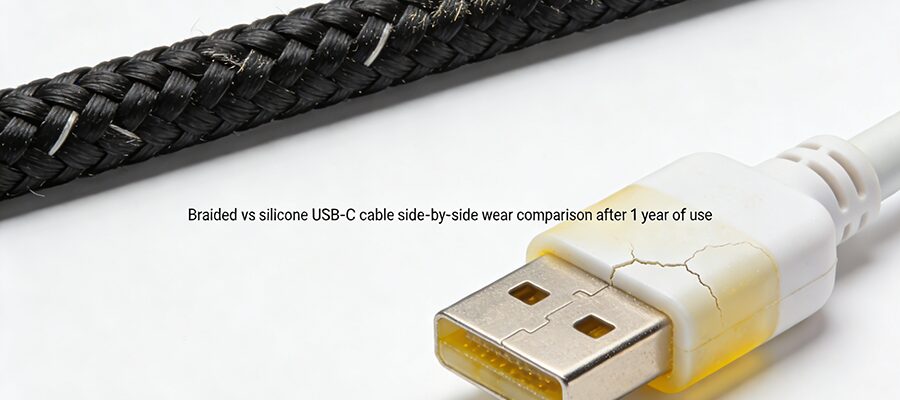
Resists scratches, scuffs, and pet bites far better than silicone
High-density (300D+) braided models show almost no wear even after 2 years of daily transport in bags with keys/other sharp items
Budget low-density braids (under $2) may pill or fray prematurely
Silicone cables use a soft rubber outer layer:
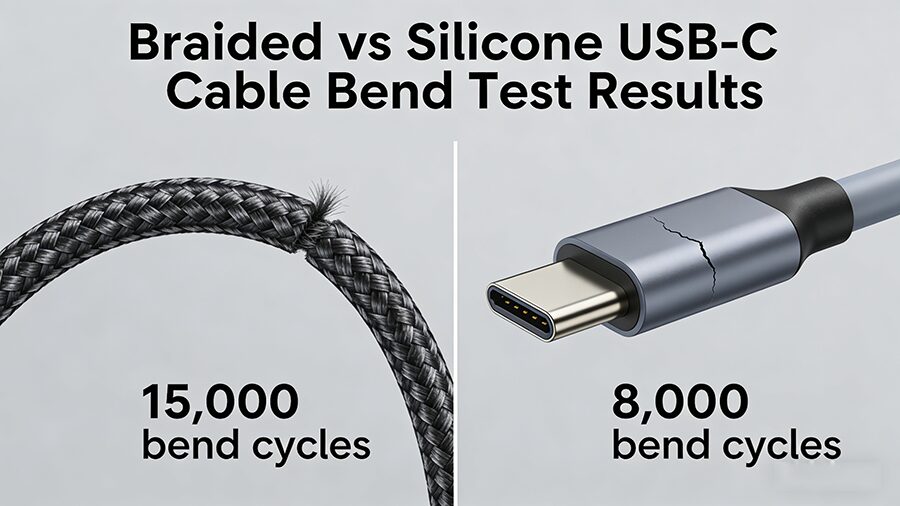
More flexible than braided options, so less stress on internal wires during regular bends
Prone to tears if cut by sharp objects, and low-quality non-UV-resistant silicone will yellow or get sticky after 6–12 months of use
Industrial-grade thick silicone (2mm+ casing) can outlast cheap braided cables
2. Use Experience
Braided cables: Stiffer structure means they lay flat on desks and almost never tangle, but can feel bulky in pockets and make a rustling sound when moved. They stay slip-free even if your hands are sweaty.
Silicone cables: Ultra-soft, matte texture feels premium to hold, and stays flexible even in -30°C weather (ideal for cold climate users). They are less rigid, so they won’t prop your phone up at a weird angle when charging on a nightstand, but will easily knot up if tossed in a bag.
3. Value For Money
Braided cables have a far lower cost per year of use, even for mid-range models. A $6 USB-IF certified braided 100W cable will last 3 years, working out to $2 per year. A comparable $10 silicone cable will last 2 years, working out to $5 per year.
The only exception is for fixed use cases: if you never move your cable, a $5 silicone cable will last just as long as a braided option, and feel nicer to use.
When to Choose Which?
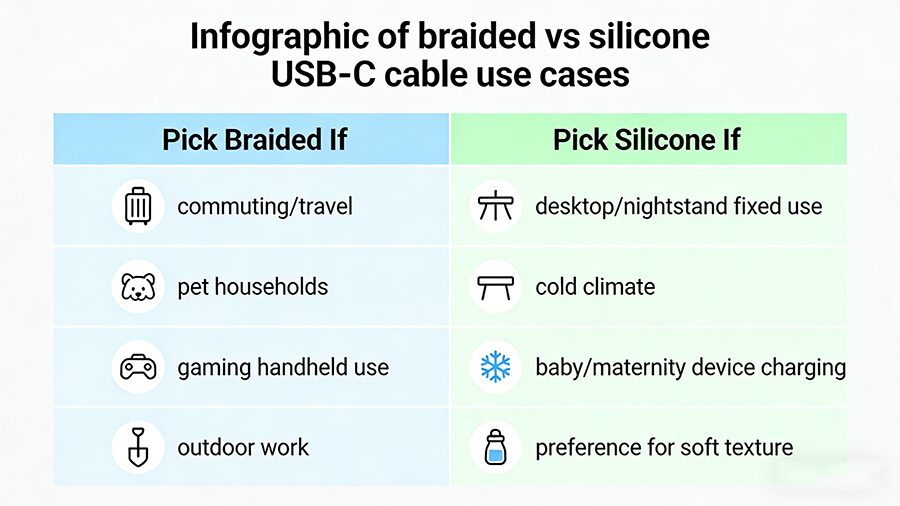
✅ Choose a braided cable if:
You regularly carry your cable in a backpack/pocket
You have pets that chew on cords
You use your cable for gaming handhelds (Steam Deck, Switch) or outdoor work
You hate untangling cables
You want the lowest long-term cost
✅ Choose a silicone cable if:
You only use the cable in one fixed spot (desk, nightstand)
You live in a climate with regular sub-zero temperatures
You use the cable for baby monitors or other maternity/kid devices (soft, no sharp edges)
You prioritize a premium, soft feel over maximum durability
Common Myths Debunked
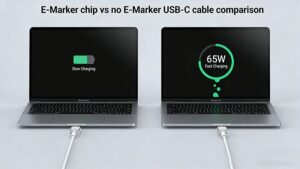
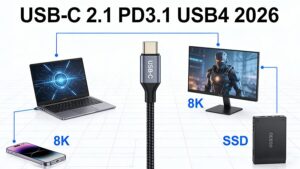
❌ Myth 1: Braided cables support faster charging than silicone Truth: Outer material has zero impact on charging speed or data transfer performance. Both braided and silicone cables can support up to 240W PD and 80Gbps USB4 speeds as long as they have the correct internal wiring and E-Marker chip.
❌ Myth 2: All silicone cables turn yellow Truth: Only cheap, non-UV-stabilized silicone yellows. Food-grade silicone with anti-yellow additives will stay clear for 2+ years.
❌ Myth 3: Braided cables are always better Truth: If you never move your cable, a silicone model will feel nicer and cost less for the same lifespan. There’s no need to pay extra for braiding if you don’t need the abrasion resistance.
Вопросы и ответы
Q: Which is safer for pet households?
A: High-density braided cables are far more bite-resistant. Silicone cables can be punctured by pet teeth easily, exposing internal copper wires and creating a fire risk.
Q: Can I use a silicone cable in a hot car?
A: We don’t recommend it. Silicone can get sticky and degrade at temperatures above 45°C, which is easily reached inside a parked car in summer. Braided cables hold up far better in high heat.
Q: Do braided cables fray over time?
A: 300D+ high-density braided cables will only show minor fuzz after 2+ years. Low-density budget braids (under $2) may fray after 6 months of heavy use.
Q: Is the extra cost for silicone cables worth it?
A: Only if you prioritize soft feel and use the cable in a fixed spot. For most users, braided cables offer better value for money.