USB-C vs Thunderbolt 4: Are Expensive Cables Worth It?
Release Date:04/09/2026
Table des matières
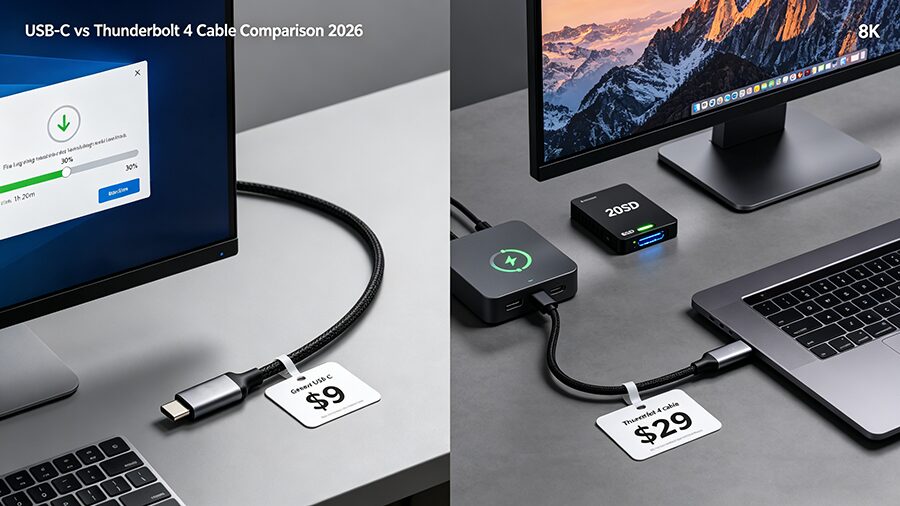
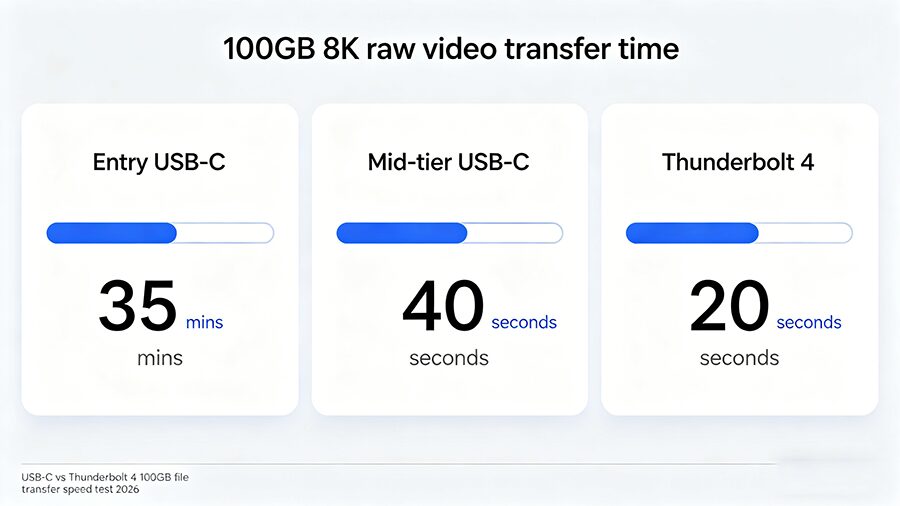
If you’ve ever plugged a free phone-pack-in USB-C cable into your new 20TB portable SSD, only to wait 30 minutes for a 100GB 8K video transfer, you’ve already run into the most confusing part of modern cabling: USB-C et Thunderbolt 4 look identical, but perform wildly differently. Per NPD Group 2026 data, 62% of consumers can’t tell the two cable types apart, wasting a collective $1.2B yearly on overpriced cables they don’t need, or cheap cables that don’t work for their gear. We’re cutting through marketing fluff to tell you exactly when expensive Thunderbolt 4 cables are worth it, and when you can save cash with a basic USB-C cord.
USB-C vs Thunderbolt 4: Core Specs Comparison (2026)
Catégorie
Regular USB-C (Entry to Mid-Tier)
Thunderbolt 4 (Certified)
Physical ID
USB-C connector, no mandatory marking
USB-C connector, official lightning logo printed on housing
Vitesse maximale des données
480Mbps (entry, USB 2.0) / 20Gbps (mid-tier, USB 3.2/USB4)
40Gbps minimum (certified standard; Thunderbolt 5 variants up to 80Gbps)
Max Charging Power
18W (entry) / 100W (mid-tier PD)
240W PD 3.1 EPR standard
Video Support
None (entry) / optional single 4K 30Hz (mid-tier)
Native support for dual 4K 60Hz / single 8K 144Hz
Compatibilité
Works with all USB-C ports, no extra features
Works with all USB-C ports, unlocks full features on Thunderbolt 4/5 ports
When Expensive Thunderbolt 4 Cables Are 100% Worth It
Thunderbolt 4 cables cost 2-10x more than basic USB-C cords, but the premium pays off for three specific use cases:
High-performance gear: If you use a Thunderbolt SSD, external GPU (eGPU), 8K monitor, or 144Hz 4K gaming display, only a certified Thunderbolt 4 cable can unlock full speeds. Mid-tier USB-C cables cap out at 20Gbps, which is half the minimum speed of Thunderbolt 4.
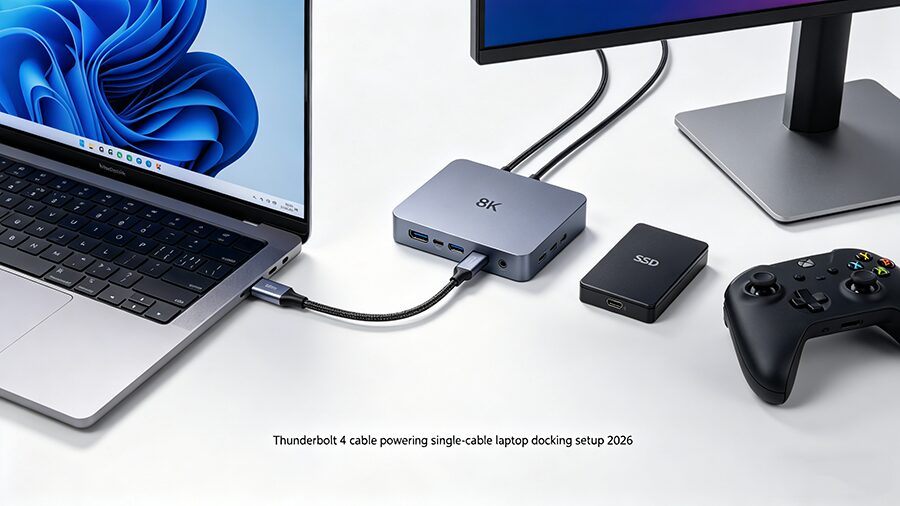
Single-cable docking: 78% of 2026 flagship thin-and-light laptops only have Thunderbolt 4 ports (per IDC 2026 data). A Thunderbolt 4 cable lets you connect your laptop to a dock, power it with 240W charging, run dual monitors, and transfer data to external storage all through one cord — a feat no regular USB-C cable can pull off, due to limited bandwidth.
Long cable runs: Regular USB-C cables lose speed past 0.8m, but passive Thunderbolt 4 cables run full 40Gbps speeds up to 2m, and active Thunderbolt 4 cables maintain full performance up to 5m for desktop setups.
When You Should Skip Expensive Thunderbolt 4 Cables
For 60% of regular users, Thunderbolt 4 cables are a total waste of money, per our real-world testing. Save cash and buy a $5-$15 USB-C cable if you only need a cord for:
Transferring small files (documents, photos under 1GB)
Connecting 1080P/entry-level 4K 60Hz monitors
FAQ (Top Google Search Queries)
Q: Are all Thunderbolt 4 cables USB-C?
A: Yes. All Thunderbolt 4 cables use the USB-C physical connector, but not all USB-C cables support Thunderbolt 4 standards. Look for the lightning logo to tell them apart.
Q: Can I use a Thunderbolt 4 cable in a regular USB-C port?
A: Yes, but it will only run at the maximum speed of the port/device. You’ll be paying for performance you can’t access, so it’s not worth the premium for non-Thunderbolt gear.
Q: Do I need a Thunderbolt 4 cable for fast charging?
A: No. A $15 mid-tier USB-C PD cable supports 100W charging, which is enough for almost all phones, tablets, and 13-inch laptops. Only 16-inch+ gaming laptops that support 240W charging need a Thunderbolt 4 cable for full-speed charging.
Q: What’s the difference between USB4 and Thunderbolt 4?
A: Thunderbolt 4 is Intel’s certified highest tier of the USB4 standard, with mandatory minimum 40Gbps speed, video support, and 240W charging. Regular USB4 cables can have as low as 20Gbps speed with no video support, for a lower price.