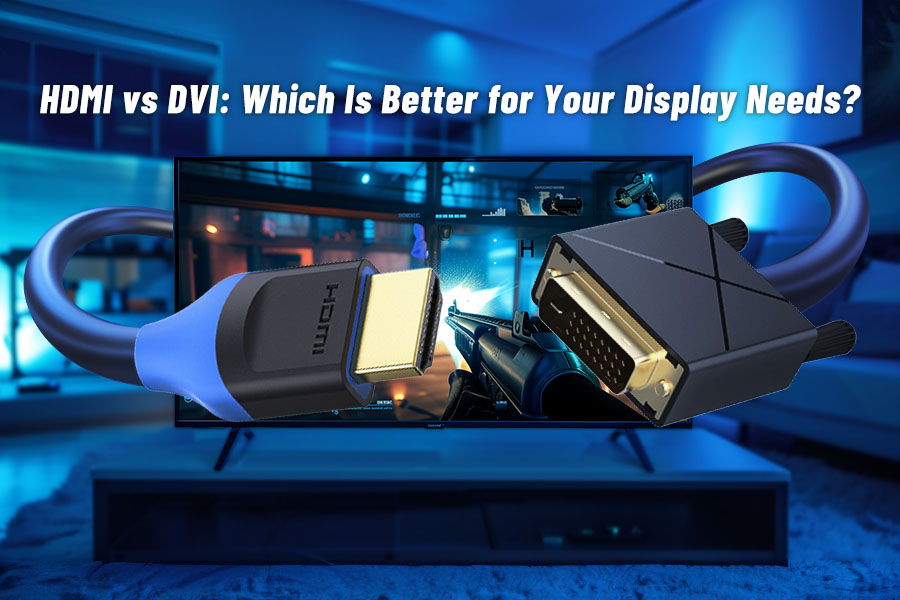
A la hora de instalar un sistema de cine en casa, un equipo de juegos o una estación de trabajo en la oficina, elegir el cable de vídeo adecuado puede influir considerablemente en la calidad de la imagen. Dos opciones habituales son HDMI y DVI-Pero, ¿en qué se diferencian y cuál es el más adecuado para usted? Veamos sus características, ventajas, desventajas y casos de uso ideales.
¿Qué son HDMI y DVI?
HDMI (interfaz multimedia de alta definición)
Introducido en 2002, HDMI es una interfaz digital diseñada para transmitir tanto señales de audio y vídeo a través de un solo cable. Se ha convertido en el estándar para dispositivos modernos como televisores, consolas de videojuegos (PS5, Xbox Serie X), reproductores Blu-ray y ordenadores portátiles.
DVI (Interfaz visual digital)
DVI, lanzada en 1999, es una interfaz de vídeo digital que se utiliza principalmente para conectar ordenadores a monitores. Se desarrolló para sustituir a estándares analógicos más antiguos, como VGA, pero carece de soporte de audio integrado.
Diferencias clave: HDMI frente a DVI
|
Característica
|
HDMI
|
DVI
|
|
Tipo de señal
|
Digital (audio + vídeo)
|
Digital (sólo vídeo) + analógico (algunas versiones)
|
|
Resolución máxima
|
Hasta 10K (con HDMI 2.1)
|
Hasta 2560×1600 (DVI-D Dual Link)
|
|
Frecuencia de actualización
|
Hasta 120 Hz a 4K (HDMI 2.1); 60 Hz a 8K
|
Hasta 60 Hz a 1080p (enlace único); 120 Hz a 1080p (enlace doble)
|
|
Soporte de audio
|
Sí (hasta 32 canales, Dolby Atmos)
|
No (requiere un cable de audio aparte)
|
|
Tamaño del conector
|
Compacto (19 clavijas)
|
Más grande (24+1 patillas para Dual Link)
|
|
Protección anticopia
|
HDCP (impide la piratería de contenidos protegidos por derechos de autor)
|
Compatibilidad limitada con HDCP (versiones anteriores)
|
|
Usos comunes
|
Televisores, videoconsolas y dispositivos de streaming
|
Monitores de ordenador, PC antiguos
|
Cuándo elegir HDMI
- Sistemas de cine en casa: HDMI transmite vídeo de alta definición y sonido envolvente (por ejemplo, Dolby Atmos) en un solo cable, lo que simplifica la configuración con televisores, barras de sonido o receptores AV.
- Juegos: Las consolas modernas (PS5, Xbox Series X) y las tarjetas gráficas utilizan HDMI 2.1 compatible con 4K a 120 Hz u 8K a 60 Hz, fundamental para la fluidez del juego.
- Streaming: Dispositivos como Roku, Apple TV u ordenadores portátiles confían en HDMI para conectarse fácilmente a los televisores con un mínimo de cables.
- A prueba de futuro: HDMI sigue evolucionando (última versión: 2.1) y admite nuevas tecnologías como HDR10+ y frecuencia de actualización variable (VRR).
Cuándo elegir DVI
- Monitores/PC antiguos: Si utilizas un ordenador o monitor antiguo que sólo tiene un puerto DVI, ésta es tu mejor opción.
- Puras necesidades de vídeo: DVI sigue funcionando bien para monitores 1080p (por ejemplo, ordenadores de oficina) en los que no se necesita audio.
- Compatibilidad analógica: Algunos puertos DVI-I admiten señales analógicas (con un adaptador), por lo que resultan útiles para conectar monitores VGA antiguos.
¿Pueden trabajar juntos?
- HDMI a DVI: Sólo transmite vídeo (sin audio). Útil para conectar un ordenador portátil (HDMI) a un monitor antiguo (DVI).
- DVI a HDMI: También sólo vídeo. Sirve para conectar un PC antiguo (DVI) a un televisor (HDMI), pero necesitarás un cable de audio aparte.