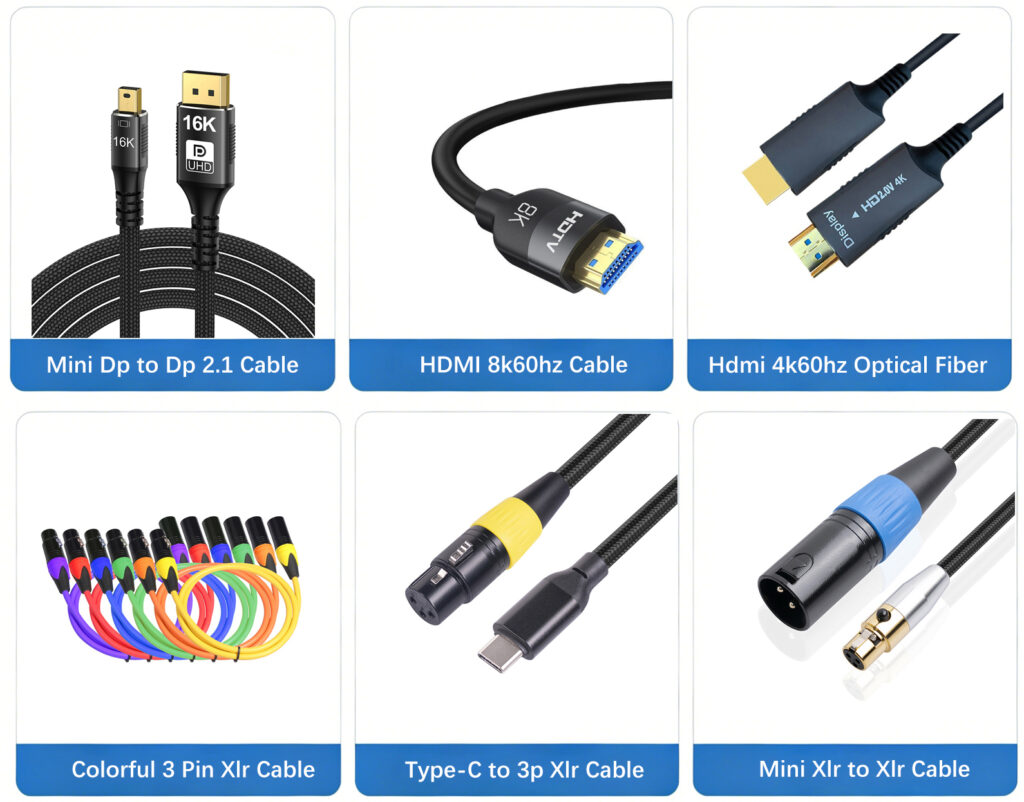
Building a custom DisplayPort cable, troubleshooting a DP no-signal issue, or just trying to understand why your DisplayPort-Kabel will not hold 4K 144Hz — it all starts with the DisplayPort pinout. Unlike HDMI’s dedicated clock lane, DisplayPort packs video, audio, control and power into just 20 pins, using a packet-based design closer to Ethernet than to older display interfaces.
This guide explains every pin on the 20-pin DP connector, what the main link lanes, AUX channel, hot plug detect und DP_PWR pins actually do, why the DP cable wiring is reversed at the sink end, how mini DisplayPort und DP++ dual mode fit in, and the most common DP cable wiring mistakes that cause flicker, black screens or EDID failures.
What Is a DisplayPort Pinout?
The DisplayPort pinout defines the assignment of every electrical signal inside a DP connector and its DisplayPort-Kabel. A standard full-size DisplayPort connector has 20 pins arranged in two rows. Those 20 pins break down into four signal groups:
- Main Link (pins 1–12): four high-speed differential lanes that carry uncompressed video and audio — this is the bandwidth engine behind 4K 144Hz, 8K 60Hz and beyond.
- AUX Channel (pins 15–17): a low-speed bidirectional link used for EDID reading, link training and DPCD device control.
- HPD (pin 18): the hot plug detect signal that tells the source a display is connected.
- Power & Ground (pins 13, 14, 19, 20): DP_PWR (3.3 V), its return, and configuration pins tied to ground.
Complete DisplayPort 20-Pin Pin Assignment
| Pin | Signal | Group | Funktion |
|---|---|---|---|
| 1 | ML_Lane 0 (p) | Main Link | Lane 0 positive differential signal |
| 2 | GND | Ground | Lane 0 shield / ground return |
| 3 | ML_Lane 0 (n) | Main Link | Lane 0 negative differential signal |
| 4 | ML_Lane 1 (p) | Main Link | Lane 1 positive differential signal |
| 5 | GND | Ground | Lane 1 shield / ground return |
| 6 | ML_Lane 1 (n) | Main Link | Lane 1 negative differential signal |
| 7 | ML_Lane 2 (p) | Main Link | Lane 2 positive differential signal |
| 8 | GND | Ground | Lane 2 shield / ground return |
| 9 | ML_Lane 2 (n) | Main Link | Lane 2 negative differential signal |
| 10 | ML_Lane 3 (p) | Main Link | Lane 3 positive differential signal |
| 11 | GND | Ground | Lane 3 shield / ground return |
| 12 | ML_Lane 3 (n) | Main Link | Lane 3 negative differential signal |
| 13 | CONFIG1 | Config | Connected to ground (or via pulldown) |
| 14 | CONFIG2 | Config | Connected to ground (or via pulldown) |
| 15 | AUX CH (p) | AUX | Auxiliary channel positive — EDID, link training, DPCD |
| 16 | GND | Ground | AUX channel shield / ground return |
| 17 | AUX CH (n) | AUX | Auxiliary channel negative |
| 18 | Hot Plug | HPD | Hot plug detect — signals connect/disconnect to the source |
| 19 | Return | Strom | Return line for DP_PWR power |
| 20 | DP_PWR | Strom | 3.3 V ±10% at up to 500 mA for adapters, active & fiber cables |
What Each Signal Group Does
| Group | Pins | Speed / Direction | What It Carries |
|---|---|---|---|
| Main Link (4 lanes) | 1–12 | Up to HBR3 8.1 Gbps/lane; DP 2.x UHBR10/13.5/20 | Uncompressed video and audio — drives 4K 144Hz, 8K 60Hz |
| AUX Channel | 15–17 | ~1 Mbps (or Fast AUX 720 Mbps), half-duplex | EDID read, link training, DPCD registers, HDCP handshake |
| Hot Plug Detect | 18 | One-way, sink → source | Tells the GPU a monitor is plugged in / unplugged |
| DP_PWR | 19–20 | 3.3 V, 500 mA | Powers passive DP++ adapters, active extenders and fiber AOC modules |
| Config / Ground | 13, 14, plus shields | - | Pins 13–14 tied to ground; connector grounds for shielding |
Mini DisplayPort vs Full-Size DP Pinout
Mini DisplayPort (mDP) uses the same 20-pin assignments as the full-size connector — only the physical housing is smaller (about 7.5 × 4.6 mm vs 16.1 × 4.6 mm). Electrically and functionally they are identical, which is why a passive mini DP to DP adapter adds zero signal conversion and no latency. The mini DisplayPort pinout therefore carries the exact same main link lanes, AUX, HPD and power pins.
Häufig gestellte Fragen
Is the DisplayPort pinout the same for DP 1.4 and DP 2.1?
Yes. DisplayPort 1.4, 2.0 and 2.1 all use the identical 20-pin connector layout. The DP version changes signal bandwidth (HBR3 up to 32.4 Gbps, UHBR up to 80 Gbps) and the transceiver electronics — not the physical pin assignment.
What is the AUX channel for on a DisplayPort cable?
The AUX channel is a low-speed bidirectional link that carries the monitor’s EDID, performs link training, reads DPCD registers and runs the HDCP handshake. If the AUX pins are miswired, your GPU cannot read the display and may fall back to a wrong or low resolution.
Can I build a DP to HDMI adapter just by rewiring the pins?
No. DP and HDMI use different signaling and protocols. A passive adapter works only if the GPU supports DP++ dual mode, which remaps the pins to TMDS internally. Otherwise you need an active conversion chip.