If you’ve ever dug through a junk drawer full of 10+ nearly identical USB-C cables, only to find none can fast-charge your laptop or transfer a 4K movie in under 10 minutes, 2026 is your year.
Between the EU’s mandatory USB-C regulations and the USB Implementers Forum’s (USB-IF) long-awaited standardized labeling rules, the messy, inconsistent USB-C era is ending. Below we break down the three core 2026 standards, what’s changing, and exactly how it affects you.
First, the regulatory backstory: Starting in Q2 2026, all laptops, tablets, smartphones, and portable gaming devices sold in the EU must include a USB-C port and meet minimum power/performance requirements. The USB-IF is also rolling out mandatory simplified labeling for all certified USB-C products that same year, ditching the confusing “USB 3.2 Gen 2×2” naming that no regular consumer understands.
These rules will push every major tech brand (Apple, Dell, Samsung, etc.) to adopt the new USB-C 2.1, PD3.1, and USB4 standards across their entire lineups by 2026, making the features mainstream worldwide, not just in the EU.
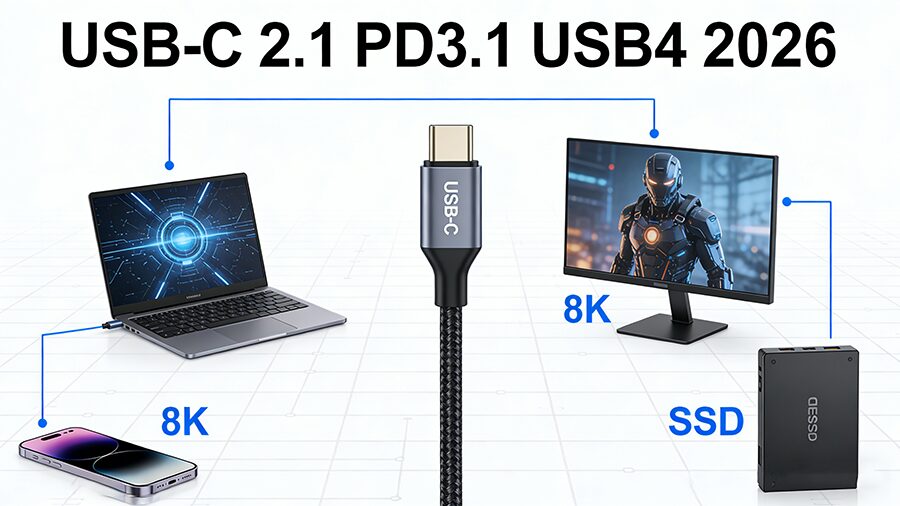
USB-C 2.1 is the physical port and cable standard that supports all new high-power, high-speed features. Unlike older USB-C ports, it’s built to handle up to 240W of power and 80Gbps of data transfer without overheating or performance drops. All 2026 devices will ship with USB-C 2.1 ports as standard, with reinforced connectors rated for 10,000+ plug cycles.
Power Delivery 3.1 (PD3.1) is the charging protocol that makes “one cable for everything” a reality. The old PD3.0 standard capped out at 100W, which was enough for phones and thin-and-light laptops, but too weak for gaming laptops, portable monitors, or even small portable electronics.
PD3.1’s Extended Power Range (EPR) pushes that limit to 240W: by 2026, most gaming laptops will ditch their bulky 2-pound power bricks for a slim PD3.1 USB-C charger, and you’ll be able to use the same cable to charge your phone, camera, and drone.
USB4 is the data transfer and display standard that eliminates the need for a pile of dongles. The 2026 baseline for all mid-to-high end devices will be USB4 2.0, which supports up to 80Gbps of transfer speed (4x faster than the most common pre-2024 USB-C speed of 20Gbps).
Even better: USB4 carries data, video, and power all at the same time. You’ll be able to plug one cable from your laptop into an 8K monitor, and it will charge your laptop, output 8K 144Hz video, and connect to your external SSD and keyboard all through that single connection.
| Характеристика |
Pre-2024 Average USB-C |
2026 Mandatory/Standard USB-C |
| Max Charging Power |
100W (PD3.0) |
240W (PD3.1 EPR; 65W minimum for laptops) |
| Максимальная скорость передачи данных |
20Gbps (USB 3.2 Gen 2×2) |
80Gbps (USB4 2.0; 20Gbps minimum for all smart devices) |
| Видеовыход |
Up to 4K 60Hz |
Up to 8K 60Hz / 4K 144Hz (DisplayPort 2.1 Alt Mode) |
| Labeling |
Vague (e.g. “USB 3.2 Gen 1”) |
Standardized badges only (e.g. “240W” / “80Gbps”) |
| Совместимость |
Hit-or-miss for high-power use |
Guaranteed for all USB-IF certified accessories |
No jargon, just real-world impact:
Say goodbye to cable clutter. One certified 240W USB4 cable will work for every device you own: phone, laptop, wireless headphones, portable charger, and Switch. No more guessing if a cable will fast-charge your device—just look for the clearly printed power/speed badge on the cable or packaging.
Ditch the pile of cables on your desk. A single 80Gbps PD3.1 cable can power your 16” gaming laptop, connect to an 8K 144Hz monitor, and transfer 100GB of raw 4K footage in 10 seconds flat. You’ll also be able to buy portable 240W power banks that can charge your gaming laptop for 4+ hours of off-grid play.
If you sell tech products in the EU, you’ll need to ensure all devices and accessories meet the 2026 USB-C standards to avoid customs holds or fines. Stock up on USB-IF certified PD3.1/USB4 cables and chargers now to get ahead of price surges in 2025.
A: Yes, for basic charging and low-speed data transfer. If you want to access 240W charging or 80Gbps speeds, you’ll need to upgrade to a certified USB-C 2.1/PD3.1 cable.
A: No. Your existing chargers, cables, and docks will still work with new devices—you just won’t get the new high-speed/ high-power features unless you upgrade.
A: No.
Thunderbolt 4 is a premium subset of USB4 with stricter performance requirements, but all Thunderbolt 4 cables and devices will work with 2026 USB4 ports. Top-tier 2026 USB4 2.0 ports are twice as fast as Thunderbolt 4, with an 80Gbps speed cap vs. Thunderbolt 4’s 40Gbps limit.