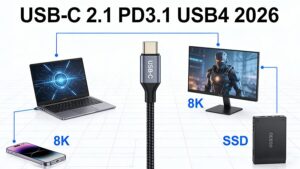
If you’ve ever waited ages for a 4K raw file to transfer or struggled with lag streaming high-res footage, you know the frustration of slow connectivity. Enter USB4 Version 2.0 80Gbps cables – the latest leap in universal serial bus tech that’s set to redefine high-speed data transfer. In this post, we’ll break down the engineering behind its doubled bandwidth, the critical role of active cable technology, and how it’s supercharging 8K video workflows and AI devices.
Bandwidth Boost: Doubling Speed with PAM-3 Encoding
The headline upgrade of USB4 v2.0 is its 80Gbps data transfer rate – double the 40Gbps ceiling of USB4 v1.0 and 8x faster than USB 3.2 Gen 1. Here’s how the tech delivers this leap:
- PAM-3 Encoding: Unlike the NRZ (Non-Return-to-Zero) encoding used in older USB versions, USB4 v2 adopts Pulse Amplitude Modulation 3-level (PAM-3), which squeezes 3 bits of data into every signal cycle (vs. 1 bit with NRZ). This cuts signal frequency needs while doubling effective bandwidth.
- Dual-Lane Aggregation: It leverages 2 lanes of 40Gbps each (up from 2x20Gbps in v1.0) to hit the 80Gbps mark, while maintaining backward compatibility with USB 3.x, Thunderbolt 3/4, and DisplayPort 2.1.
| USB Standard | Max Bandwidth | Encoding Scheme | Key Compatible Protocols |
|---|---|---|---|
| USB4 v2.0 | 80Gbps | PAM-3 | USB 3.x, TB 3/4, DP 2.1 |
| USB4 v1.0/1.1 | 40Gbps | NRZ | USB 3.x, TB 3/4, DP 1.4a |
| USB 3.2 Gen 2×2 | 20Gbps | NRZ | USB 3.x |
| USB 3.2 Gen 1×1 | 10Gbps | NRZ | USB 3.x |
Active Cable Tech: The Backbone of Stable 80Gbps Transmission
Passive USB cables work for short distances (≤0.8m for 40Gbps), but 80Gbps signals degrade rapidly over copper wiring. Active USB4 v2 cables solve this with specialized hardware:
- Redriver/Retimer Chips: Built-in semiconductor chips amplify and regenerate weakening signals, ensuring data integrity over longer distances (up to 3m for copper active cables, or 10m+ with fiber options).
- Multi-Layer Shielding: Braided copper + foil shielding blocks electromagnetic interference (EMI) – critical for maintaining PAM-3 signal accuracy (more noise-sensitive than NRZ).
- Low-Power Design: Chips draw minimal power from the host, avoiding overloading while delivering consistent performance.
Real-World Impact: Empowering 8K Video & AI Devices
The 80Gbps bandwidth isn’t just a number – it’s unlocking tangible efficiency gains in professional workflows and next-gen tech.
3.1 Supercharging 8K Video Production
A single second of 8K 10-bit RAW footage can exceed 10GB – a load that used to require clunky RAID arrays or Thunderbolt docks. USB4 v2 changes this:
- Real-Time 8K RAW Transfer: Direct streaming of 8K RAW from professional cameras (e.g., Sony FX9 II, Canon EOS R5 C) to editing workstations, eliminating intermediate storage and cutting workflow time by 50%.
- Multi-Stream Workflows: Connect 2+ 8K cameras to a single hub for simultaneous live production, ideal for broadcast studios or event coverage.
3.2 Accelerating AI Device Performance
Edge AI and portable AI tools demand low-latency, high-bandwidth data transfer. USB4 v2 delivers:
- Edge AI Inference: Devices like NVIDIA Jetson AGX Orin or Google Coral can stream 4K video feeds from multiple cameras in real time, cutting inference latency by 40% compared to USB4 v1.
- AI Training on Peripherals: External GPU enclosures transfer training datasets at 80Gbps, matching the performance of internal GPU slots in mid-range workstations – a game-changer for small-scale AI teams.
Conclusion
USB4 v2.0 80Gbps cables aren’t just a cable upgrade – they’re a foundation for the next wave of high-speed tech. The PAM-3 encoding leap and active cable engineering make 80Gbps stable and accessible, while real-world use cases in 8K video and AI are already transforming professional workflows. As more devices adopt the standard, we’ll see even more innovative applications emerge – from VR/AR setups to industrial IoT sensors.