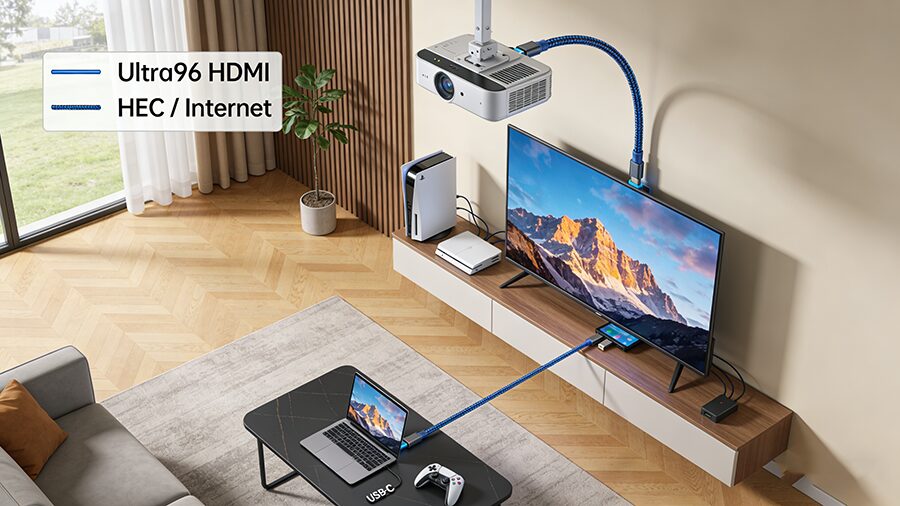
As 8K streaming, 4K 240Hz gaming, and immersive home theaters become mainstream, high-speed HDMI cables are evolving faster than ever. The launch of HDMI 2.2 and its Ultra96 HDMI cable (96Gbps bandwidth) marks a leap forward, but the future isn’t just about speed—it’s about integration. How does the classic HDMI with Ethernet (HEC) fit into this new era? And how do USB-C “all-in-one” cables and fiber optic HDMI complement, rather than replace, traditional setups? Let’s dive in.
HEC (HDMI Ethernet Channel)—the dedicated data channel for internet connectivity in HDMI cables—isn’t going anywhere. While newer standards like HDMI 2.2 prioritize raw bandwidth (96Gbps for Ultra96 cables), HEC remains critical for:
- Smart TV Networking: Directly connect your 8K TV to the internet via HDMI, avoiding Wi-Fi lag.
- Multi-Device Sync: Stream content across soundbars, gaming consoles, and Blu-ray players on a single Ethernet backbone.
- Abwärtskompatibilität: Works seamlessly with older HDMI 2.0/2.1 devices, ensuring your existing setup stays relevant.
No single cable “wins”—they’re designed to work together. Here’s how:
- Strengths: 96Gbps bandwidth (supports 4K@240Hz, 8K@60Hz), retains HEC for networking, and uses a familiar HDMI connector (no need to replace ports).
- Am besten für: Fixed home theater setups (e.g., connecting a gaming PC to a 4K 240Hz monitor or 8K TV to a soundbar).
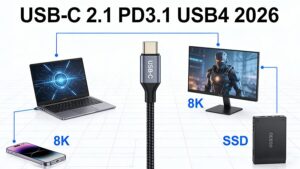
- Strengths: Transmits video, data, and power (100W+) over a single port—ideal for laptops, tablets, and portable monitors.
- Beschränkungen: Max bandwidth (USB4 v2: 80Gbps) still trails HDMI 2.2, and HEC-like networking requires extra software support.
- Am besten für: Mobile setups (e.g., a MacBook Pro connecting to a portable 4K monitor und charging simultaneously).
- Strengths: Transmits 4K/8K signals over 30m+ with zero signal loss (copper HDMI degrades beyond 10m).
- Beschränkungen: Higher cost and less flexible than copper; HEC requires separate Ethernet integration.
- Am besten für: Large homes (e.g., connecting a media server in the basement to a living room projector).
The goal? Fewer cables, more flexibility. Here’s what to expect by 2027:
- “One Cable, One Network”: Ultra96 HDMI with HEC will act as the backbone, handling high-speed AV and internet.
- Hybrid Ports: TVs/monitors will feature HDMI 2.2 + USB-C combo ports, letting you switch between fixed and mobile devices effortlessly.
- Fiber as “Invisible” Infrastructure: Pre-wire new homes with fiber optic HDMI for long-distance runs, paired with Ultra96 copper cables for short, high-bandwidth links.
The future of high-speed HDMI with Ethernet isn’t about replacing old cables—it’s about building a unified ecosystem where Ultra96, USB-C, and fiber optic cables play to their strengths. For now, prioritize Ultra96-certified HDMI 2.2 cables (look for the gold badge!) to future-proof your setup. As 8K and 4K 240Hz become standard, your wiring will thank you.
Have questions about upgrading your home theater? Drop a comment below!